| Home |
| Links |
 |
 |
OLDE ENGLISH BULLDOGGE (OEB)
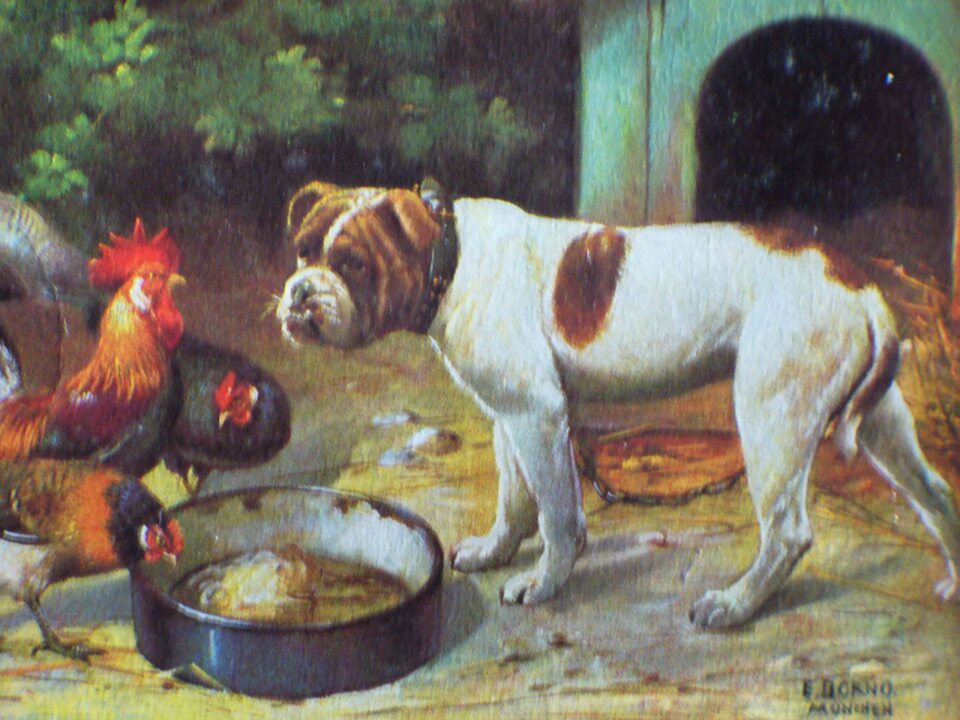
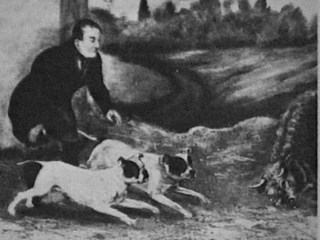
Der ursprüngliche Bulldog stammte von den Britischen Inseln und wurde für den Bullenkampf gezüchtet. Der Bullenkampf galt etwa vom 13. bis zum 18. Jahrhundert als Nationalsport in England, deshalb züchtete man die frühe Bulldogge als wilden, furchtlosen Hund mit enormer Kraft. Zu dieser Zeit war Schönheit nur zweitrangig von Bedeutung. Ca. 1778 setzte man dem Bullenkampf ein Ende, da viele Menschen sich diesem aufgrund seiner Grausamkeit widersetzten.
Anfang der 70er startete David Leavitt ( USA),
USA),
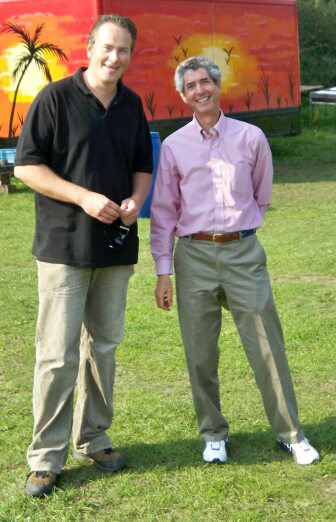
( Mr. DAVID LEAVITT & Holger )
nach dem Linienzuchtschema Dr. Fechimer’s ( Ohio State University ) mit der Zucht der Olde English Bulldogge. 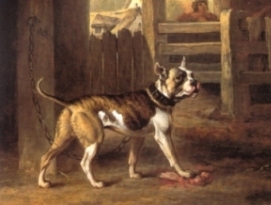
Zielsetzung war die Bulldogge des 18. Jahrhunderts zurückzuzüchten, denn er war mit der Englischen Bulldogge sehr unzufrieden und strebte das Ziel an gesunde, vitale und fruchtbare Tiere zu züchten. Die Hunde sollten frei deckend, frei atmend und in der Lage sein ihre Welpen selbst zur Welt zu bringen. Im Startgenpool befand sich 50% Englische Bulldogge (EB).
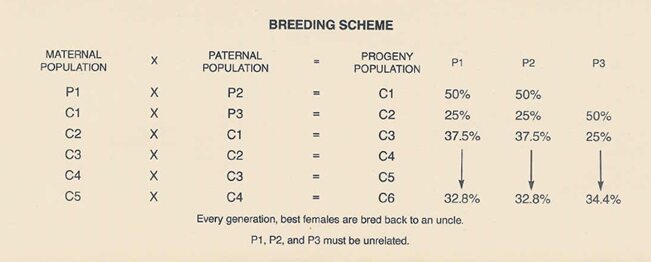
Mr. Leavitt startete mit zwei Schemata und zog die Möglichkeit zukünftiger Outcrosse in Betracht.
Interview with Mr. David Leavitt (USA) done by H. Luckas
Holger 1 : You started up with a linebreeding scheme and used 2 unrelated schemes with 3 unrelated dogs. Please tell us a little bit about the foundation dogs such as BullMead`s Ajax, BullMead`s Crib ( in my opinion an awesome bulldogge ) and BullMead`s Polly. Out of which combinations were these dogs ? Tell us a little bit about the beginning !
David Leavitt 1: I started with four unrelated schemes but had a couple of genetic problems crop up that led me to drop 2 lines, because of fear of having the conditions show up again. Ajax was a third generation dog with a lot of drive. Crib was a 6th generation dog with a friendly, upbeat temperament and a healthy, bully body. Polly was my barn guard and a loving but very tough dog. She was an F1 dog with an EB sire and a Pit Bull/ Bull Mastiff dam.
Holger 2: Do you think that the genetic pool of Leavitt dogs today is big enough or would it make sense to do an outcross if allowed ?
David Leavitt 2: The two conflicting goals of outcrossing are to do it before a genetic problem is brought out by excessive in-breeding and finding an outcross that doesn`t introduce a new genetic fault. Through the years I have approved a few outcross dogs. While judging a show in Holland this september I found an excellent female who I approved, after seeing her hips x-rays. Also a whole new line is being created. It has been bred for a few generations. It will be submitted for inclusion once it is stabilized and has proven itself healthy. I am committed to the belief that occasional outcrosses are necessary for genetic health but must be done under tight control and not with the anarchy of the American Bulldog 7/8th rule .... There is apt to be conflict of interest if the owner of the outcross dog is the one allowed to make the decision about coming into a breed. Too often they do not have the experience or the impartiality necessary and are often most interested in making money and upgrading the value of their dog. Unbiased breed experts must the ones to decide.
Holger 3: If you take a look at the Leavitt Bulldog of today are you totally satisfied with the result ? Are there breeders that are following your standard honestly, you told me already that LOYAL GUARD Kennels are doing a good job ?
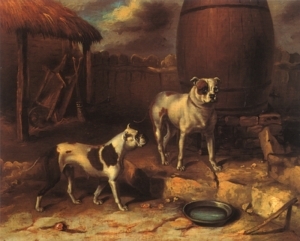
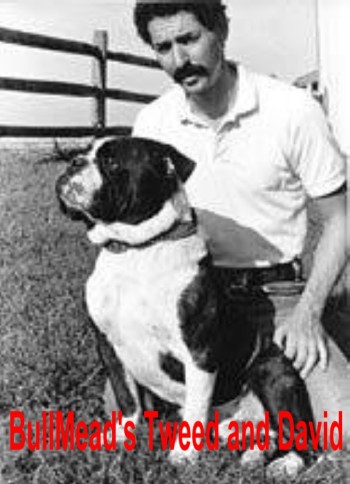
David Leavitt 3: The sucess of the phenotype of today`s dogs must be graded based first on how closely their appearance matches the pre 1835 Bulldog. Granted there was a range from cobby to leggy, in their depictions in art, but I have picked the historical dogs that I like the best and who I feel possessed the healthiest bodies. My standard is based on these old dogs. It is a dog like Tweed and his sister Rosa and not like my early dogs such as Polly and Mox. The majority of dogs that the LBA is registering today match my ideal. My two main breeders in the US are the Courvilles and the Merganthalers and I`m very happy with their performance.
Holger 4: What is very interesting to me is the matter of fact that you started up with 1/2 English Bulldog and the other half Bull Mastiff, American Pit Bull Terrier and American Bulldog. We have bred ourself American Pit Bull Terriers for many years and I would like to know which line of APBT you used for your breeding programm ( i.e. dogs of Heinzl, Bert Sorrells, Florida or James Crenshaw ) ?
David Leavitt 4: In 1971 I bought a Pit Bull/Bull Mastiff female whose litter was bred for boar hunting in California by Mr. Murphy. Her extreme drive and intelligence was passed to her progeny. She also threw some dogs with animal aggression. The other Pit Bull female I used was from Red Connors in New Hampshire, who bred Captain Crunch, the largest Pit Bull of his day and a beautiful, drivey specimen. She was not a great lokking dog but I used her because of the high quality of her brother. Sadly her pups took after her.
Holger 5: You told me personally that you would like to identify the gen for epilepsy, is it a problem in the breed ?
David Leavitt 5: One of the first generation dogs in the 80`s came down with epilepsy and I was so horrified that I dropped the whole line in fear that his brothers and sisters could carry it too. This dog was a total outcross so the condition was not due to inbreeding in any way. LB`s have not displayed this disease since then but having so much EB in their make-up, it is a constant danger. I have heard about some epilepsy in the OEBKC lines.
Holger 6: We talked about that there is no longer a problem with ED, but you told me that you saw before some years in europe that the teeths are getting bad. What could be the reason and how could we manage to get them better ?
David Leavitt 6: I have not seen ED although I`ve heard rumors of one case. Last year I saw dogs with unerupted teeths for the first time. It appears to come from one stud and he won`t be bred again. This is not a crippling genetic problem like HD or epilepsy but is a real concern none the less. We will need to check all breeding dogs and breed away from the problem.
Holger 7: You are still chairman within the LBA and connected to the breed, but you quit breeding in 1995 ( as far as I know ) what was the reason ?
David Leavitt 7: It is very hard to breed healthy dogs, with a desired phenotype and temerament. Finding good homes for them in the US, I found even more difficult. Even after many years of screening callers, with enough dog produced, there will be mistakes and some dogs go to bad homes and tragic outcomes. This is what wore me down. The other tiring aspect was that after someone had one of my dogs for a couple of years, many became instant experts and they started doing things their way which usually meant their main concern was making money on the dogs. Contrary to my rules, brother and sister were bred to each other and required hip x-rays ( required from the beginning ) were ignored and then I was threatened with lawsuit because I wouldn`t issue registration papers.
I got into humane work in the late 80`s. I fostered and found homes for seized fightimg dogs ( after they passed tests and showed they were not people or animal aggressive ). For the past 18 years my house dogs were special needs terriers that I rescued. Through my work with animal shelters I saw a small part of the millions of dogs and cats that are killed as excess, here in the US. I finally had my dogs coming out the way I wanted them, felt I had nothing left to prove and although I was finding homes for the pups, I felt I was adding to the pet over population problem in America.
Holger 8: What is your advice to a breeder of the OEB ?
David Leavitt 8: My advice is to take time picking out your new dog. Every puppy can steal your heart. If you want a pet your task is much easier as most OEB`s make good loving pets, if a genetic problem doesn`t show itself and endanger the dog. Breeding stock is another matter. Pups change so much as they mature that your best selection criteria are the quality of temperament, health, movement and conformation of the parents. Be your own harshest critic. Everyone makes mistakes. If your pup doesn`t mature into a excellent example, then don`t breed him.
I also feel strongly that all dogs need at least obedience training. It improves the human/dog relationship and builds teamwork like nothing else. I hope some of you will go farther and compete in dog sports like agility, iron dog or certify your dog for therapy work and let them spread their love for people in a positive way at hospitals and hospices.
Holger: Thank you so much for spending your time and I hope to meet you again and special thanks for a great breed ! Best regards and good luck and a lot of health
David Leavitt : Thank you for your interest
Einige andere Züchter starteten Ihren eigenen Rückzüchtungsversuche, hieraus resultieren z.B.: Hermes Bulldogge (grösser und schwerer als die Leavitt Bulldogs), Olde Victorian Bulldogge (VB) und Mr. Chadde JoliCoeur startete 1990 mit der Zucht der Renascence Bulldogge (RB). OEB ist heute der Oberbegriff für die Rückzüchtungsversuche. David Leavitt nennt seine Hunde zur Abgrenzung nunmehr LEAVITT BULLDOGS (LB). (Obwohl auf einigen Internetseiten von Leuten, die wahrscheinlich "den tiefen Teller" nicht erfunden haben nachzulesen steht, dass der Leavitt Bulldog keine echte Olde English Bulldogge sei, muss an dieser Stelle hervorgehoben werden, dass DAVID LEAVITT allein der Rassebegründer ist und bis heute durch ihn die Hunde gekört und insbesondere Anwärter für Outcross-Verpaarungen durch ihn genehmigt werden müssen. Leider splitteten sich verschiedene Züchter in andere Verbände auf, da sie zum Teil ihre Tiere nicht röntgen liessen oder mit Epilepsie vorbelasteten Tieren gegen den Willen von David Leavitt züchteten.) DAVID LEAVITT ist Teil der Geschichtsbücher und kein Anderer ! ! ! Jede andere Darstellungsweise ist "Volksverdummung" und zeugt höchstens von Realitätsverlust !
Der OEB von heute ist ein optimaler Familien- und Begleithund, der sich durch seine Loyalität gegenüber seiner Familie und Kinderliebe auszeichnet.